

Industries
One platform. Shaped to your industry.
Because we build AI-ERP for each client, it speaks your industry's language: your units, your processes, your compliance and your reports. Each page below lists the ERP features that sector needs and why.
Why does an ERP need to fit your industry?
An industry-fit ERP records material in the units your trade uses, follows your real production or service process and produces the documents your customers and regulators expect. A tannery counts hides by area, a mill by count and a distributor by batch and expiry. AI-ERP is built per client, and these 64 pages show what we would build for each sector.
12 industries
Engineering and metals
Machined, cast, forged, fabricated and electrical products.
ERP for engineering and manufacturing
Delivery dates slip and nobody can say which shortage, machine or test is the cause.
28 features in 7 groups
ERP for auto components
Weekly schedule revisions mean the production plan is out of date as soon as it is printed.
27 features in 7 groups
ERP for foundry and casting
Melting, moulding and rejection registers are kept separately, so yield per order is never known.
25 features in 7 groups
ERP for forging
Input weight per piece drifts upward and nobody notices until month-end yield falls.
26 features in 7 groups
ERP for machine tools
Quotations are priced before engineering confirms the configuration, so margins erode.
27 features in 7 groups
ERP for sheet metal fabrication
Quotations are guessed from weight and experience; actual job cost is never compared.
26 features in 7 groups
ERP for valves and pumps
Thousands of size, class and material combinations make BOMs hard to keep accurate.
25 features in 7 groups
ERP for fasteners and bearings
Stock in kilograms and sales in pieces never reconcile because piece weights are outdated.
24 features in 7 groups
ERP for electrical equipment
Copper and CRGO price swings turn fixed-price tender orders into losses.
26 features in 7 groups
ERP for wires and cables
Metal and compound losses are known only at month-end stock, not by stage or order.
25 features in 7 groups
ERP for steel rolling mills
Mill yield is calculated monthly, so a bad roll pass or furnace setting is found weeks late.
24 features in 7 groups
ERP for electronics manufacturing
One missing low-value component stops a production run of thousands of boards.
26 features in 7 groups
12 industries
Textiles, leather and lifestyle
Fibre to garment, hide to shoe, metal to jewellery.
ERP for textiles and apparel
Material at dyers, printers and stitchers is invisible, so stock and WIP are guesses.
26 features in 7 groups
ERP for spinning mills
Bale quality and mixing recipes are kept in registers, so yarn quality problems are hard to trace.
27 features in 8 groups
ERP for weaving and powerloom
Loom production is known only when grey fabric is counted at folding.
25 features in 7 groups
ERP for dyeing and processing
Party fabric is mixed or misplaced in the godown, leading to quantity disputes.
24 features in 7 groups
ERP for garment export
Time-and-action calendars live in separate spreadsheets, so slippage is noticed too late.
26 features in 7 groups
ERP for hosiery and knitwear
Yarn and fabric weights do not reconcile with garment pieces produced.
25 features in 7 groups
ERP for home textiles
Sets made of several components are short on one piece when packing starts.
23 features in 7 groups
ERP for leather and tanneries
Hides vary in size and grade, so stock counted in pieces never matches usable area.
24 features in 7 groups
ERP for footwear
Size runs multiply order and stock lines until spreadsheets break down.
25 features in 7 groups
ERP for gems and jewellery
Gold issued to karigars and received back is reconciled by hand, and losses hide in the gaps.
26 features in 7 groups
ERP for furniture and handicrafts
Sample changes are not tracked, so bulk production uses the wrong finish or size.
25 features in 7 groups
ERP for carpets and rugs
Carpets on looms in villages have no recorded progress or expected completion date.
25 features in 8 groups
12 industries
Process industries
Batch and continuous plants: pharma, chemicals, polymers, building materials.
ERP for pharma formulations
Material status (quarantine, approved, rejected) is tracked on labels and registers, not enforced by the system.
28 features in 7 groups
ERP for bulk drugs and apis
Genealogy from API batch to intermediates and raw material lots is assembled by hand.
25 features in 7 groups
ERP for chemicals
Tank and drum stock is estimated from dips and not adjusted for concentration.
26 features in 7 groups
ERP for paints and coatings
Batch corrections for shade and viscosity are not fed back into formulas.
25 features in 7 groups
ERP for plastics and polymers
Actual shot weight and cycle time drift from the quotation, eroding margin unseen.
26 features in 7 groups
ERP for packaging
Estimates are calculated by hand and vary between estimators.
25 features in 7 groups
ERP for rubber and tyres
Mixed compound ages in the store and is scrapped or causes curing defects.
25 features in 7 groups
ERP for paper and printing
Waste paper yield and moisture deductions are argued with suppliers without data.
25 features in 7 groups
ERP for cement and building materials
Block yield and slab quality are not recorded, so stone pricing is guesswork.
26 features in 7 groups
ERP for ceramics and tiles
Stock is kept by design and grade, so orders ship with mixed batches and shades.
25 features in 7 groups
ERP for glass and glassware
Pack-to-melt efficiency is unknown because breakage is not recorded by stage.
24 features in 7 groups
ERP for agrochemicals and fertilisers
Seasonal demand is planned on instinct, causing shortages in season and expiry after it.
24 features in 7 groups
10 industries
Food and agri
Farm produce to packed food, with yield, shelf life and food safety.
ERP for food processing
Raw material quality at receipt is not linked to the yield it produced.
26 features in 7 groups
ERP for dairy
Fat and SNF are lost between collection and the plant without anyone noticing.
24 features in 7 groups
ERP for rice and flour mills
Milling yield is known only at stock counts, not by lot or variety.
24 features in 7 groups
ERP for edible oil
Oil recovery from seed is known only at month-end stock checks.
25 features in 7 groups
ERP for sugar mills
Harvest and supply calendars are planned in registers, causing uneven cane arrival.
23 features in 7 groups
ERP for spices
Cleaning and grinding losses are not measured by lot.
24 features in 7 groups
ERP for tea and coffee
Green leaf to made tea ratio and grade mix are not analysed by day or supplier.
25 features in 7 groups
ERP for beverages and bottling
Seasonal peaks are met with shortages of preforms, closures or labels.
24 features in 7 groups
ERP for seafood and meat export
Yield from raw material to finished product is not tracked lot by lot.
25 features in 7 groups
ERP for seeds and agri inputs
Contract grower production and payments are tracked in registers.
24 features in 7 groups
8 industries
Trade and distribution
Stockists, distributors, dealers, retailers and exporters.
ERP for trading and distribution
Stock across several godowns and branches is known only by phoning each one.
26 features in 7 groups
ERP for fmcg distribution
Scheme claims to principals are filed late or incompletely, losing money.
24 features in 7 groups
ERP for pharma distribution
Near-expiry stock is found after the company's return window has closed.
24 features in 7 groups
ERP for building materials dealers
Mixed units such as bags, kg, boxes and square feet make stock unreliable.
25 features in 7 groups
ERP for electronics and appliance dealers
Serial numbers are recorded inconsistently, complicating warranty and brand claims.
24 features in 7 groups
ERP for auto dealers and spares
Superseded and alternate part numbers lead to wrong sales and false stock-outs.
25 features in 7 groups
ERP for retail chains
Head office cannot see store stock and sales in time to replenish well.
25 features in 7 groups
ERP for import and export
Landed cost is estimated because duty, freight and clearing bills arrive separately.
25 features in 7 groups
10 industries
Projects and services
Sites, contracts, fleets, warehouses, hospitals and institutes.
ERP for construction
Cost against BOQ budget is known only after the project's accounts are reconciled.
26 features in 7 groups
ERP for real estate
Unit availability is out of date across sales teams and brokers.
23 features in 7 groups
ERP for epc and infrastructure
Drawing releases, procurement and site needs are tracked in separate tools.
25 features in 7 groups
ERP for solar epc
Many small projects are tracked in spreadsheets with no single status view.
23 features in 7 groups
ERP for interiors and fit-out
Design changes and variations are approved informally and billed late or never.
23 features in 7 groups
ERP for logistics and transport
Trip profit is unknown because fuel, tolls and advances are recorded separately.
24 features in 7 groups
ERP for warehousing and 3pl
Client stock reports do not match physical stock at audits.
25 features in 7 groups
ERP for services and agencies
Timesheets are incomplete, so billable hours are lost.
24 features in 7 groups
ERP for hospitals and clinics
Pharmacy and consumable expiries are found too late.
24 features in 7 groups
ERP for education institutes
Fee dues across instalments and concessions are hard to track.
23 features in 7 groups
In action
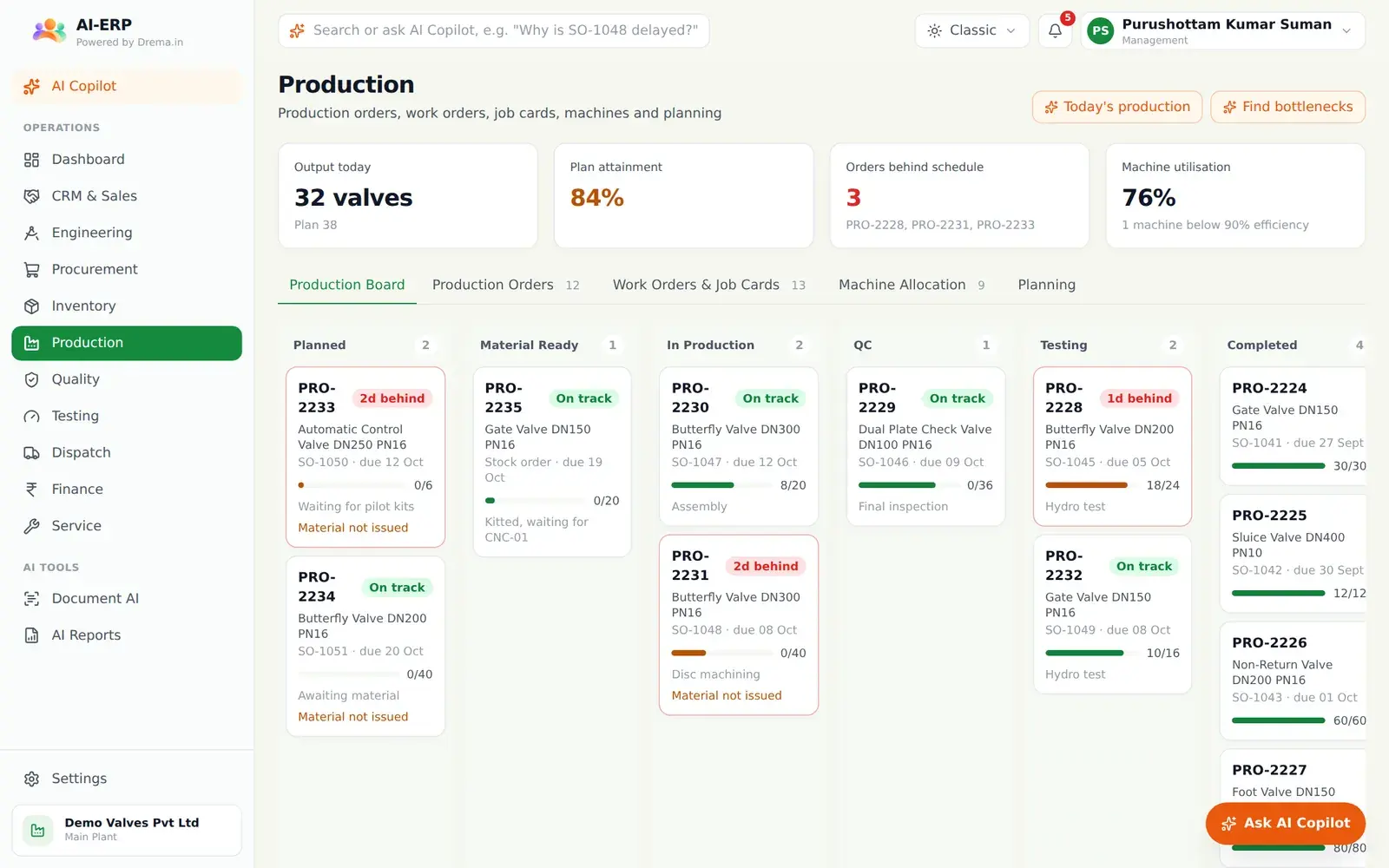
Example: a valve manufacturer
Our live demo runs a valve manufacturer from enquiry to invoice: engineering drawings and BOMs, material planning, CNC work orders, hydro and pressure testing, dispatch and service. The AI copilot spots a material shortage behind a delayed order and raises the purchase request.
Don't see your industry?
If your business runs on orders, stock, people and money, AI-ERP can run it. Tell us how you work today and we'll show you what your ERP would look like.

Free 30-minute consulting call
Let's design the ERP your business actually needs.
Tell us about your business and your team. The AI-ERP team will map your processes and show you what AI-ERP would look like for you.